2026 has been a year of growth for the Bad Ass Coffee of Hawaii. The coffee cafe continues to expand its national footprint, and to achieve its ambitious goals, the brand is leaning into a mix of disciplined operations, distinct brand positioning, and high-impact marketing.
Chief Brand Officer Iain Douglas and Rob Baiocco of agency-of-record The BAM Connection sat down to discuss how the company is scaling with intention while staying true to its Hawaiian roots, and the marketing strategies that help franchisees win locally and nationally.

Bad Ass Coffee of Hawaii has been expanding rapidly. What’s driving that growth, and what role has marketing played?

Iain Douglas: Our growth comes down to disciplined brand building and consistent execution across every touchpoint. We’ve really sharpened our Brand DNA and activated it end-to-end, from a more dynamic in-store experience led by our teams, to record-setting LTO performance, up more than 400 percent over prior benchmarks, to a fully connected consumer journey powered by our loyalty framework and local marketing system.
We opened 18 new stores last year with experienced franchisees who know how to win in their markets, and we’re seeing same-store sales growth ahead of the category. That tells us the model is working. At the core, it’s about delivering on a simple promise: we empower and energize people to crush their day.
Rob Baiocco: From a marketing standpoint, we think about it as a balance between what we call “Brand Builders” and “Brand Bangers.” Brand Builders are the always-on storytelling, primarily through social right now, that reinforce our message, “Make it a Bad Ass Day.” Brand Bangers are more campaign-driven, high-impact activations designed to create buzz and drive traffic. When those two things work together, alongside strong LTOs, you get both awareness and real foot traffic at the store level.
As you scale nationally, how do you maintain the authenticity of a Hawaii-inspired brand across diverse markets?
ID: It starts with our origin story. The “Bad Ass Ones” were the donkeys carrying coffee down the Kona mountains; that spirit of grit and adventure defines who we are. “Badass” isn’t just a name, it’s an identity. As we grow, we don’t dilute that, we translate it. Our franchisees bring the brand to life in ways that resonate locally, while the Hawaiian spirit remains constant. That balance between authentic heritage and local relevance is what allows us to scale without losing who we are.
RB: And from a marketing perspective, that authenticity is a huge advantage. There are so many rich elements to draw from Hawaii, the attitude, the product innovation. The challenge is focus. We’ve worked to prioritize the biggest opportunities like leaning into the Hawaii story, elevating “badassness,” and spotlighting standout products like Coffee Cubes, so the brand shows up consistently and powerfully.
What does your growth roadmap look like over the next 12 to 24 months?
ID: There’s a significant runway ahead, but we’re approaching it with discipline. The addition of our COO, Tom Wylie, reinforces that we’re focused on operational excellence and on building strong, profitable stores.
We’re not chasing unit count. We’re proving the model, scaling with the right partners, and growing market by market with intention. That’s how you build a sustainable brand.
What tools and support are you providing franchisees to help them succeed early on?
ID: We’ve elevated the entire franchise system. Operators now have access to robust performance dashboards, hands-on training, and Aloha U, our live platform for onboarding, playbooks, and marketing activation.
What really sets us apart is collaboration. These systems aren’t dictated top-down, they’re built with input from multi-unit operators and refined through real-world feedback. That continuous loop is a major competitive advantage.
RB: And that extends to marketing. The brand provides what I’d call ‘air cover,’ the national messaging that builds differentiation and emotional connection. But at the local level, franchisees are empowered to build community. We’ve launched ‘local social’ so each store can have its own presence alongside the national brand. That allows operators to connect directly with their customers in a way that’s authentic to their market.
The coffee category is crowded. What differentiates Bad Ass Coffee, and how do you communicate that?
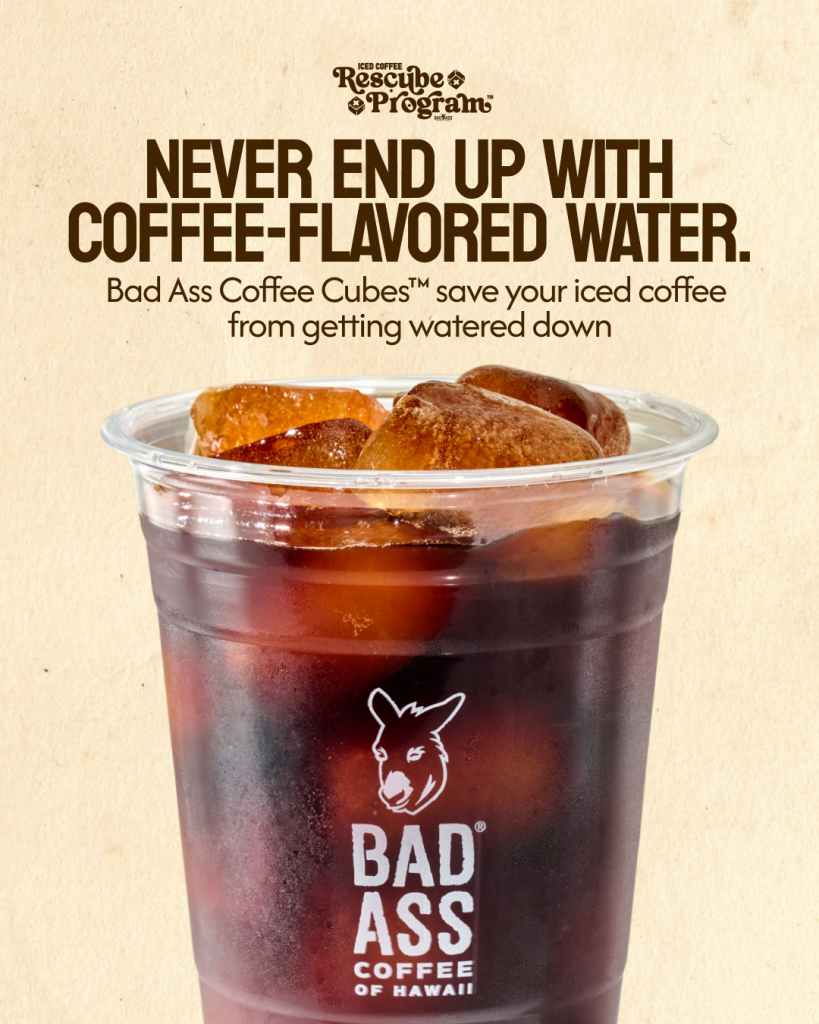
ID: We win by delivering a more distinctive product, experience, and emotional connection. Yes, we have premium Hawaiian coffee with authentic sourcing and exceptional quality. But it goes beyond that. We operate a retail-plus-café model, with more than 30 curated bagged coffees alongside handcrafted beverages. We’ve built a community-first, Ohana-driven approach. And we innovate, like with our Coffee Cubes, which ensure your iced coffee never gets watered down. But ultimately, we’re not just serving coffee, we’re fueling people to show up stronger in their day.
RB: That’s where ideas like ‘Rescubes’ come in. It worked for three reasons: it’s a true point of difference, it taps into a universal consumer frustration, everyone’s had that watered-down iced coffee, and it was brought to life with smart, engaging creative. It’s the kind of idea that makes people say, ‘Why hasn’t anyone done this before?’ That’s powerful. And now we’re looking to take it even bigger, beyond social, into in-store, and into broader activation this summer.
How do you balance national brand-building with localized marketing?
RB: It’s everything. Brand-building creates differentiation and emotional connection. Local marketing is what actually rings the register. You need both. If you only do national, you’re missing the community connection. If you only do local, you lack a compelling reason for people to choose you in the first place. The magic is in the combination.
ID: That’s exactly right. Our system is designed to support both strong national storytelling paired with tools that empower franchisees to execute locally.
For franchisees, what are the most important marketing principles to focus on at the store level?
RB: First, know your customers and your community. Use local social, create store-specific moments, and offer things that make your location feel unique. Second, deliver a great experience. Marketing might get someone in the door, but what happens in-store determines whether they come back. And finally, make it fun. Make it ‘badass.’ People are looking for energy and positivity in their day, and this brand is built to deliver that.
ID: I’d add that success comes from consistency. When franchisees fully embrace the brand—its energy, its purpose, its systems, and execute it locally, that’s when everything clicks. That’s when you build not just traffic, but loyalty.